July 15th: Ubud to Munduk, Bali
Preface here with: I’m not an expert in anything, especially not in comparative religion. This is all based on me reading some wikipedia articles, some other sources (like the US Department of State website, which has some old PDFs about this topic that I suspect they forgot to delete in the recent purge), and just talking to people. All opinions are my own, and I’m sure I’m wrong about stuff. Anyway, our guide told us about his beliefs (he’s a Hindu, most Balinese people are), which includes the belief in a single God, of which all the Hindu gods (Wisnu / Vishnu, Brahma, etc) are all manifestations. Kind of like a Catholic trinity thing, I guess. Because I am the way I am, I started digging.
Indonesia has a pretty complicated story about religious freedom. Indonesia guarantees religious freedom in its constitution, but has a pretty particular Henry Ford (you can have whatever color you want, as long as you want black) approach to freedom. In particular, you have freedom of religion as long as your religion is established, monotheistic, and has (I think - sources vary) a recognized Prophet or founder. These rules were put into place by a council on religious affairs that was under the power of Islamist supremacists in the 1950s, and it was more or less widely seen as an attempt to quash Hinduism.
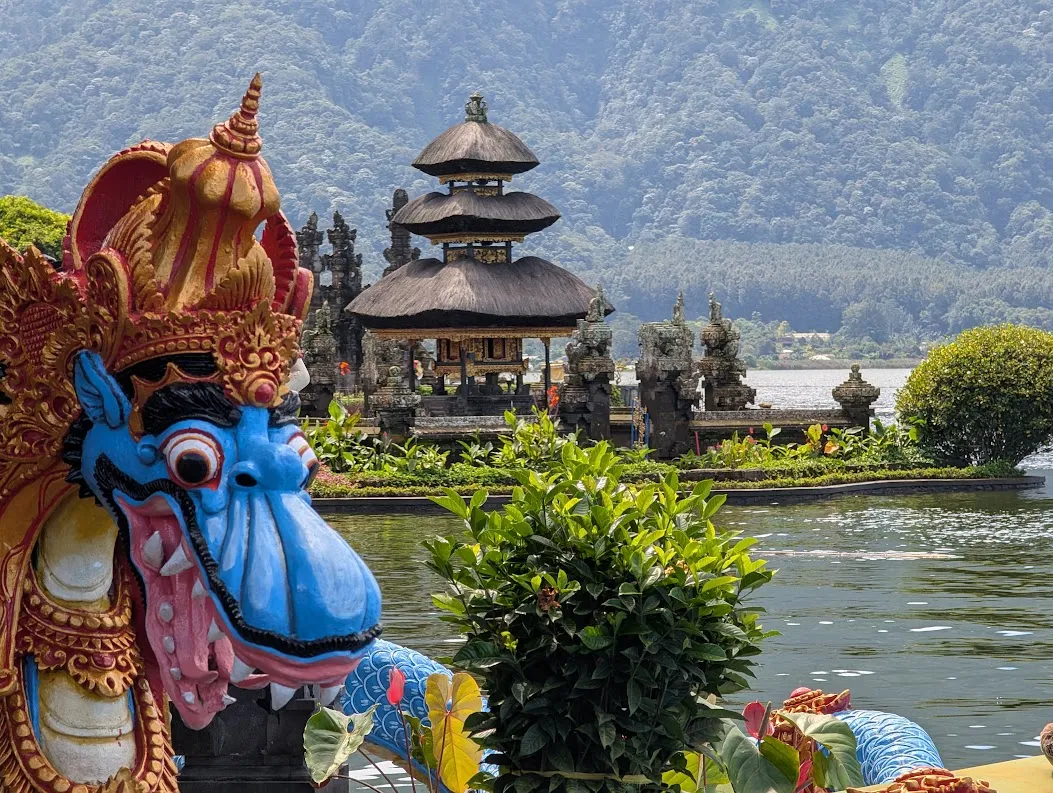
In response, the Hindus in Indonesia (mostly Bali, it’s the only Hindu-majority island) regrouped, and pointed out that yes, they have a lot of sacred texts, and many denominations of Hinduism (Vaishnavism, Shaivism, Shaktism, Smartism) believe that one of the gods is the supreme god (Vishnu, Shiva, Shakti, and the Absolute Divine Without Form, respectively). So Balinese Hindus recognize Ida Sanghyang Widhi Wasa as the one God above all, and all other Hindu gods are manifestations of that one. Therefore, Hinduism qualifies as a “religion” and you are free to worship it. This apparently took a lot of give and take. I bet you could make a good movie about all of this. I’m going to be reading A Modern Hindu Monotheism: Indonesian Hindus as ‘People of the Book’ once I get back stateside and can pick up a copy.
What fascinates me about all of this is that it is both a sincere belief (Balik was definite when he was describing his beliefs) and something of a mandatory belief for the purposes of following a law. I’m honestly not certain how I feel about this. In America, the Church of Satan does this thing where it explicitly positions itself as a religion in order to make use of religious exemptions that are given to (primarily Christian) religious organizations, especially ones that they feel are antithetical to the freedom of choice that the Satanists value. I don’t think that this would work here (for two reasons, but the first is just: there’s a ruling body that gets to decide whether or not something is a Religion in Indonesia, and I doubt that they would so rule, no matter how earnest the lawyers are). But in the US there’s a veneer of broader freedom: freedom to have any religion at all means you do have to allow Satanists and Pastafarians and Discordians. That last one is my own weird religion of choice; i’m a pope. This isn’t useful here (and in fact breaks Indonesian law, see below), as Discordianism is not a recognized religion.
Indonesia also bans blasphemy. Officially, this criminalizes everyone who deviates from one of the six officially recognized religions in the country. In practice, what will get you thrown in the hoosegow is stuff like: complaining about the volume of the adhan when you live near a mosque, provocatively eating pork rinds on TikTok, serving alcohol to someone named Muhammad, and so on. Personally, I find it interesting that the vast majority of blasphemy cases I was able to find were blasphemy against Islam.
On the one hand, I understand wanting freedom from religious violence. If you’re trying to pull together a country that is multi-ethnic, multi-religious, and as multi-everything as Indonesia is, you're going to have to do a lot of work to find common ground. So, state-recognized religion, freedom to choose one of the big six, and a “nudge nudge wink wink” they say they won’t ban Shinto or Jewish beliefs (they say). But at the end of the day, blasphemy is just “someone else did a thing that offends me”, and I don’t know if this is the anarchist or the autistic in me, but yeesh does that not make sense at all. Like, at all.
The overwhelming majority of everyone in every religion uses that religion as a lens to make sense of the world, a way to form community with others who share common beliefs and practices. Even though I’m a “I would prefer not to” when it comes to checking a religious box, I miss things about my time as a Catholic. I miss the rituals, and most importantly I miss the community. I’m also a part-time Wiccan, and I do love the Wiccan rede: “An it harm none, do as you will.” It is so clear and simple, yet so complex and challenging to live by. That is my lens, a beautiful and challenging distillation. I don't have a ton of religious community though.
At the end of the day, you can find supremacists for every religion. You’ve got Christian Supremacists more or less running the US government, there’s a lot of Hindu supremacist violence in India, Islamic supremacists in government here and elsewhere, Zionists committing genocide in Gaza. Religious (or ethnic) supremacists are not a required outcome of Religion (or ethnicity), but rather just a sad way that people use the little power they have to oppress each other, and it kind of bums me out.
Indonesia does not allow me to be an atheist, a Discordian, or a Wiccan. You are one of the six accepted religions or nothing else, and if you go out of your way to obviously break the religious rules of your religion (or offend one of them), you are going to jail. Demand avoidance if nothing else would make me Prefer Not To. Religion is non-senary (non binary but for six), genders are non-binary, everyone can be everything or nothing. Stop trying to force everyone into a category. An it harm none, do as you will. Let other people live their lives.
Our guide dropped us off at the Munduk Moding plantation, which is a working coffee farm and resort. More on agriculture (and probably less preachy) here tomorrow.
Conversation happens inside — sign in to Overstory to read and write comments.