July 14th: Ubud, Bali
Everyone here always says “thank you” when we enter and exit a restaurant, or a hotel. Like as we leave for the day’s excursion, the folks at the front desk thank me as I walk by. I know people are just being pleasant, and tourism is a big industry, and there’s all kinds of reasons why normal human interactions sometimes baffle me, and also I’m just a little teeny bit totally autistic, so there’s all sorts of ways for me to understand why this is weird, but it is weird.
It is like when a colleague says “how are you doing?”, they are really just marking the opening gambit of a conversation. They rarely want to hear the actual truth. My autism puts my brain in a state where my gut reaction is to take these questions literally. My nearly fifty years of experience studying the behavior of neurotypical humans tells me to say “fine, fine”. Thus it is: when a lot of people say “thank you”, I do not say “you’re welcome!” It is what my brain urges following the script. I feel weird both ways. I feel weird for not saying “you’re welcome” when someone says “thank you”, and I feel weird about being thanked for just kind of, existing? In this space at this time, here in a restaurant I guess I am buying food from you.
Instead, I just say “thank you” back. I want to communicate mainly that I appreciate everything that everyone is doing here. The restaurant and hotel staff is sometimes hired on day rates, and have a job when there are tourists. Bali is one of the wealthiest islands in Indonesia, mainly due to tourism. They also grow a lot of food (agriculture employs more people, but tourism makes more money). In some way, Chrissy and I are the natural resource to be converted into currency. Of course, we have a wonderful time and get to learn all kinds of things about a place we had never seen before, so there is an exchange here. I am glad that I can experience this, and I am glad that the Bali I spend my money in supports artists - our guide Balik works as a wood carver nine months of the year and a tour guide for three. The tour guiding supports the wood carving.
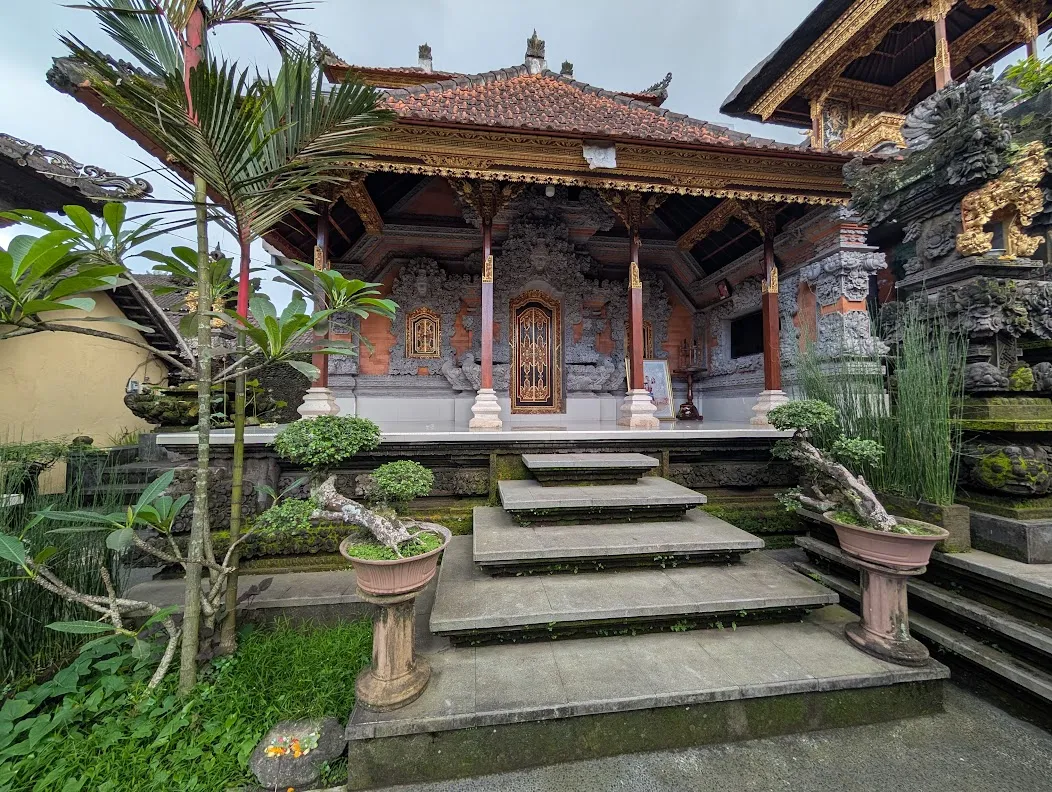
A typical Balinese family compound has five sections. The northern section (shown above) is the house where the eldest members of the family live. It has a higher foundation than all the other residences (the temple, off to the right above, in the northeast, is higher - more on the temple later). The door is also lower, so people visiting the family elders have to duck their head to go in, showing respect.
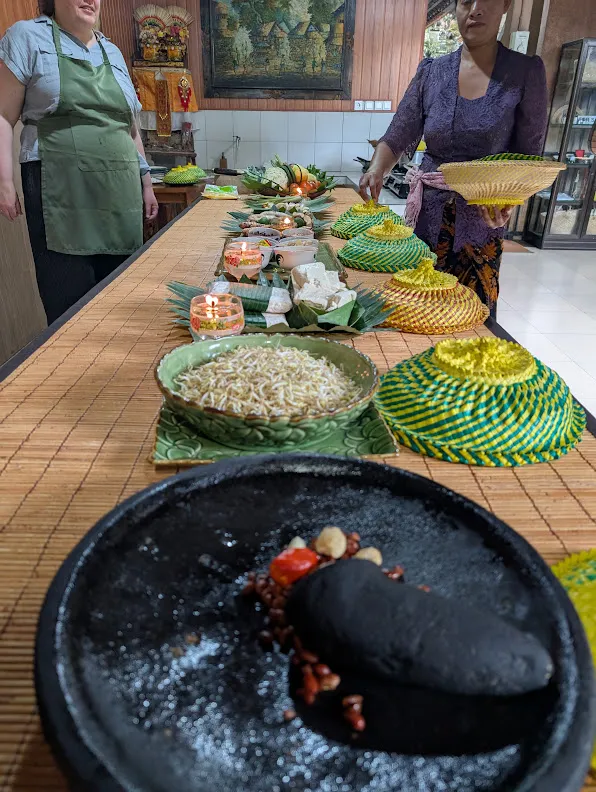
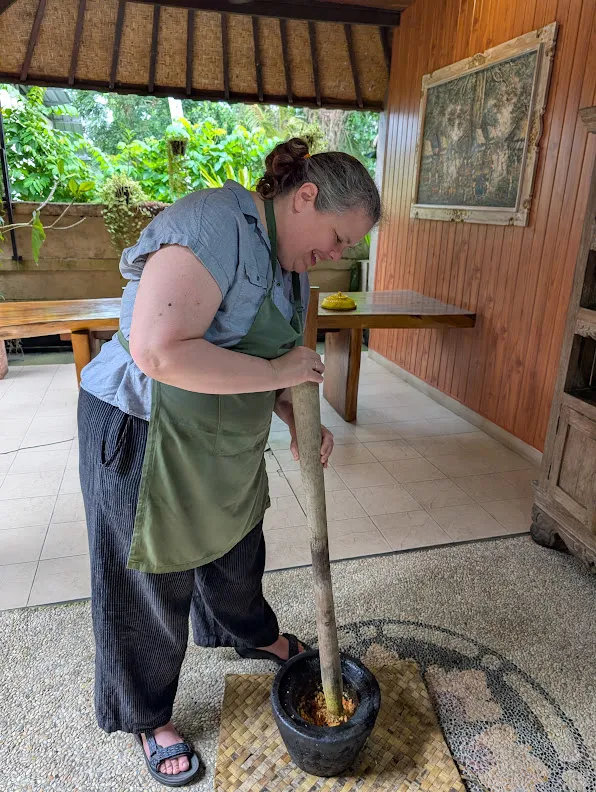
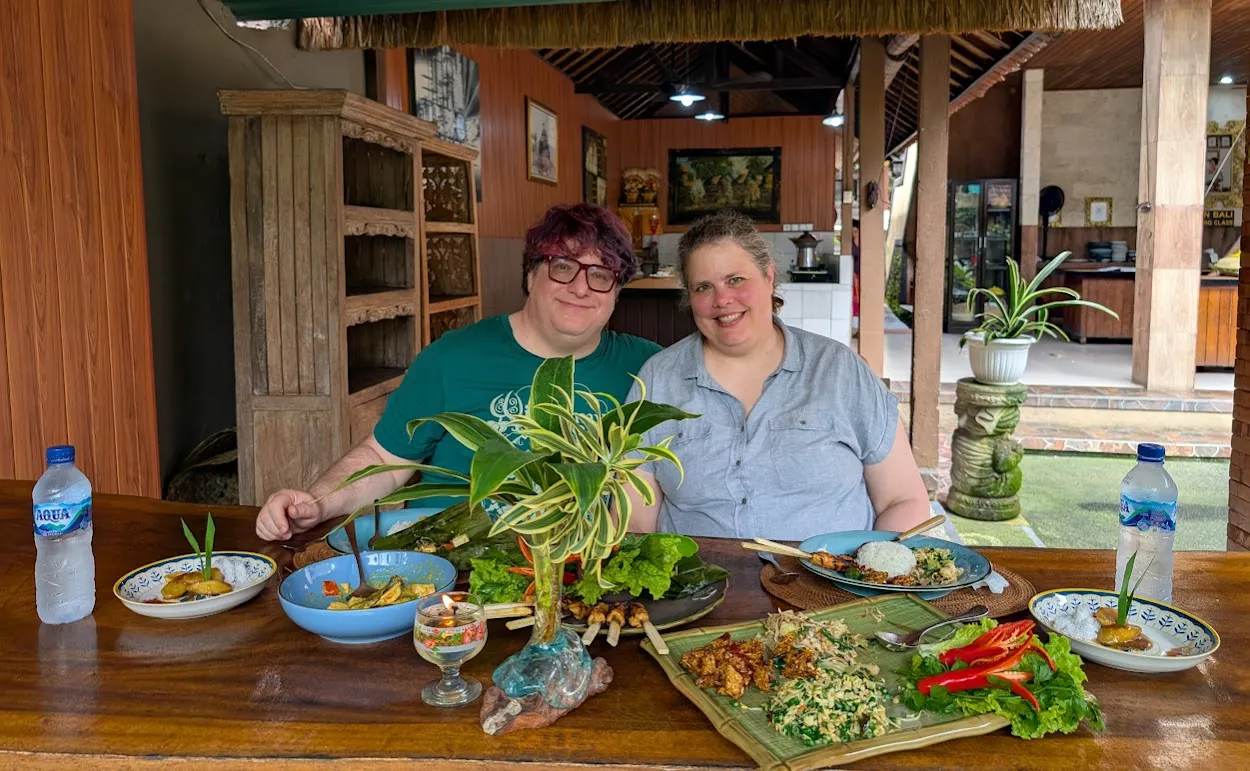
Today we are taking a cooking class in the western building of the compound. There is another class finishing up as we arrive (early). We arrive everywhere early- traffic is so unpredictable that you always sort of need to be early. I don’t know if this is an idiosyncrasy of Balik, the tour agency, or working with Americans in particular (who are notoriously upset when people are not precisely on time for something, unlike a lot of other nationalities), but Balik is always early to pick us up, and we always get where we are going early. Today, we’re making a “mother” sauce- a yellow curry sauce, which gets segmented into regular curry, a peanut sauce, and several other uses.
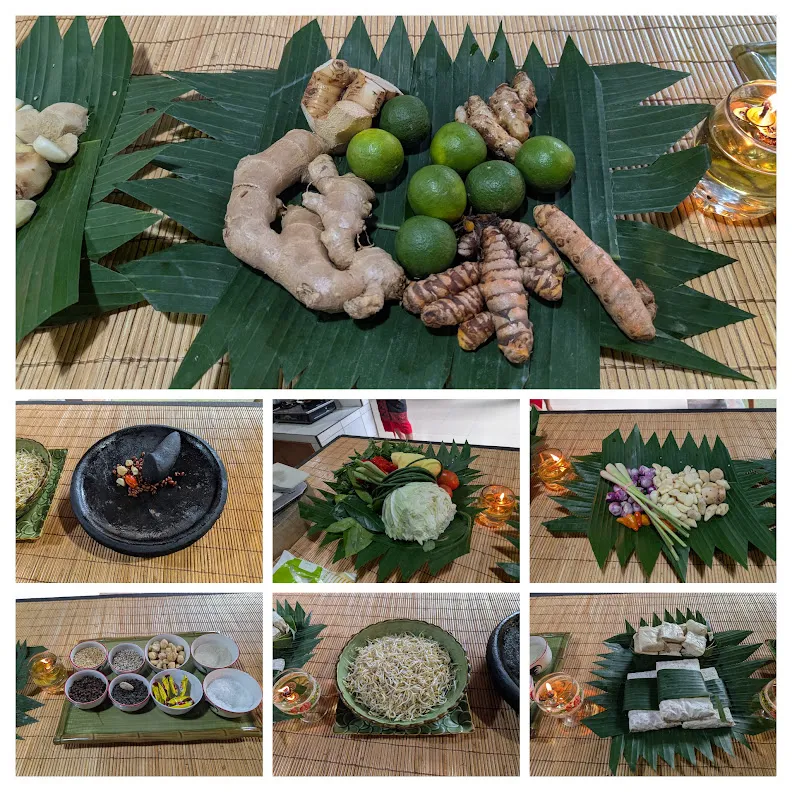
I did get a paper copy of all our recipes, and I suppose I could document every thing we did, but I’ll just recount my impressions and experiences here.
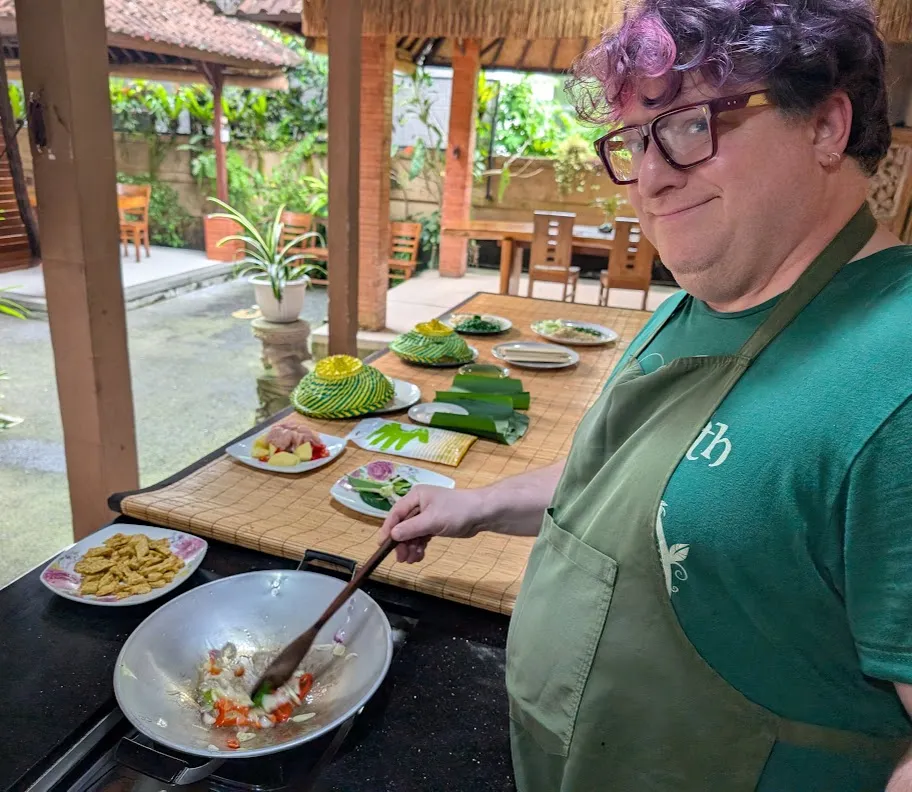
I really don’t like tempeh, but it turns out I’ve never had fried tempeh, just baked or steamed. Fried tempeh is great. I’ll leave that as a general lesson: fry stuff.
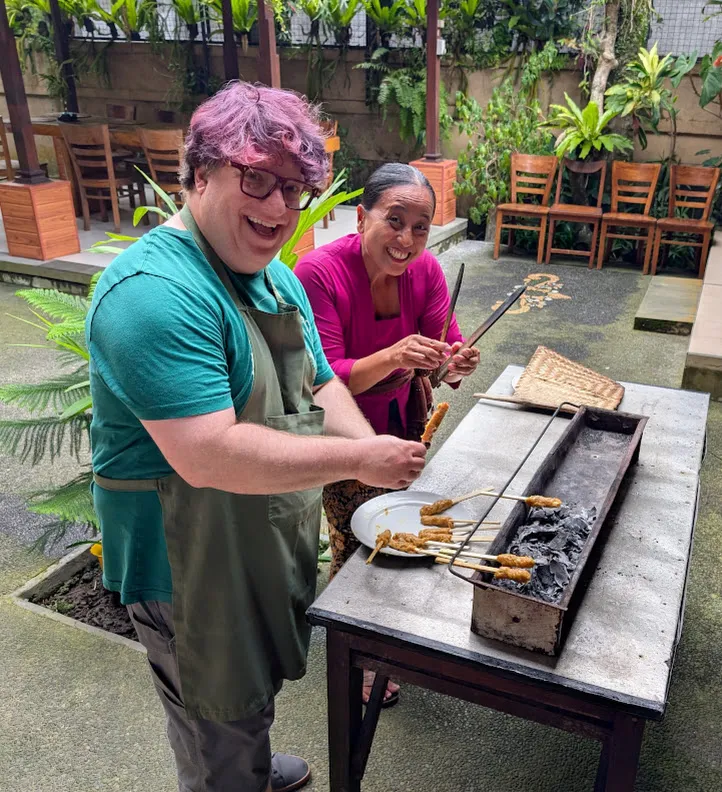
Balinese sate, pronounced like satay (which originated in Java, but I think of it as a Thai thing) is usually made from minced meat. You mince the chicken finely, mix in a peanut sauce directly, and then spread the meatballs, kebab-style on the sticks for grilling. I like this more than marinated meat on a stick.
Every single measurement of spices or sugar or anything (even coconut milk) was like “okay, add a tablespoon of sweet soy”, but the teacher would every single time put an extra half tablespoon (or half scoop or half teaspoon, whatever measuring device was being used for that ingredient) in and say “for good luck”. So the recipes say “1T sweet soy sauce”, but in practice, it’s 1.5T. This is probably like how fancy cookbooks call for salt, but actually mean Kosher salt, which is about half as dense as iodized salt, so if you follow the recipe directly you’re over-salting (unless you buy kosher salt, which you should do).
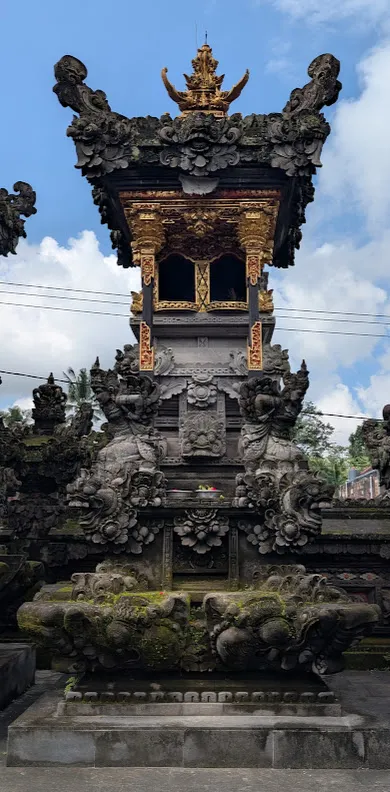
The family temple, which they were gracious enough to let us visit (wearing sarongs, of course) contained a lot of shrines, each for a different purpose. There was one shrine with three little compartments, one each for Brahma, Wisnu and Siwa. There was another shrine for a god of the mountains. Other shrines that I cannot remember the names of.
After the cooking class, it was time for a rest. I got a massage, which was pretty great; I’d never really had a massage before. No funny business, just a lot of relaxed muscles and aromatherapy.
Dinner was a dance and buffet at the hotel. Going to be honest here: the food was not super-great. The sauces and spices, I loved. But I’ve experienced this a lot in Bali- they cook the heck out of their meats. The chicken curry was a good curry, but boy howdy the chicken was nearly inedible. Same goes for the beef stew. Great flavors, chewy beef. Still, we were there for the dancing.
I don’t have 100% coverage on this statistic, but between watching the Kecak dances the other night, plus these traditional dances (there were two others, but the videos did not turn out all that well as I was paying more attention to watching the dances than I was to making a good video recording of the dances), I have come to the conclusion that male Balinese dancers all wear masks, and the women don’t. I have no knowledge as to why- other south Asian dance traditions don’t put the men in full-body costumes. On the other hand, I’m not speaking as an expert in any of these things. I guess the Kecack singers were all men, and none of them wore masks, but they weren’t the main dancers. The Monkey King, the Evil King; they all were men in costume.
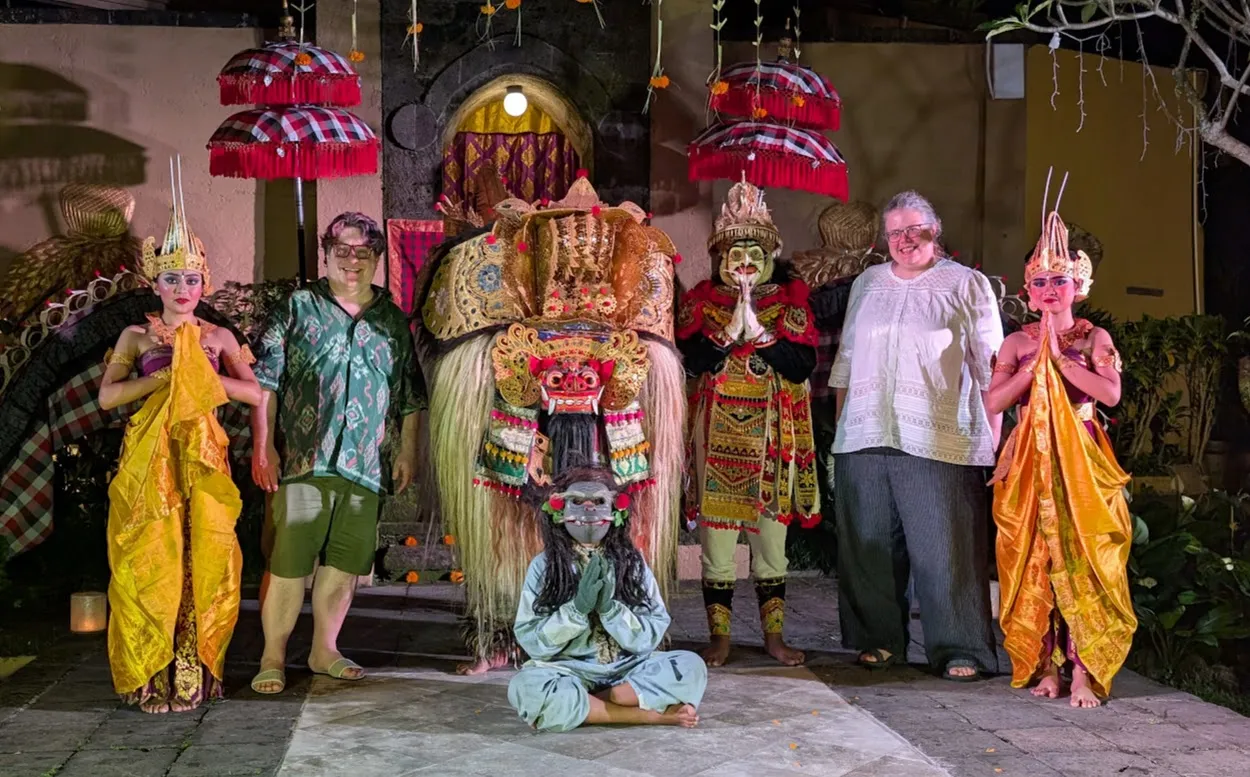
I, for one, would love to see some dudes try to do that thing with the eyes and the half-smile that the woman dancers pull off.
Shout outs:
Paon Bali Cooking Class - www.paon-bali.com - they were welcoming and great teachers. I had a lovely time.
Wapa Di Ume Ubud - wapadiumeubud.com - the hotel we stayed in for the first few nights of our trip. Tomorrow (well, today as I write this, but tomorrow from the perspective of this post) we are heading to a new hotel. More to come!
Conversation happens inside — sign in to Overstory to read and write comments.