July 13th: Ubud, Bali
There are actually spiders everywhere you look, almost anywhere you go. In Bali there’s just a lot of big ones that I don’t see all that often. I won’t directly embed any spiders, but if you want to see one: here you go. I learned later about the manual focus mode on my phone camera, so I’ll be able to get more, better, spider shots in the future.
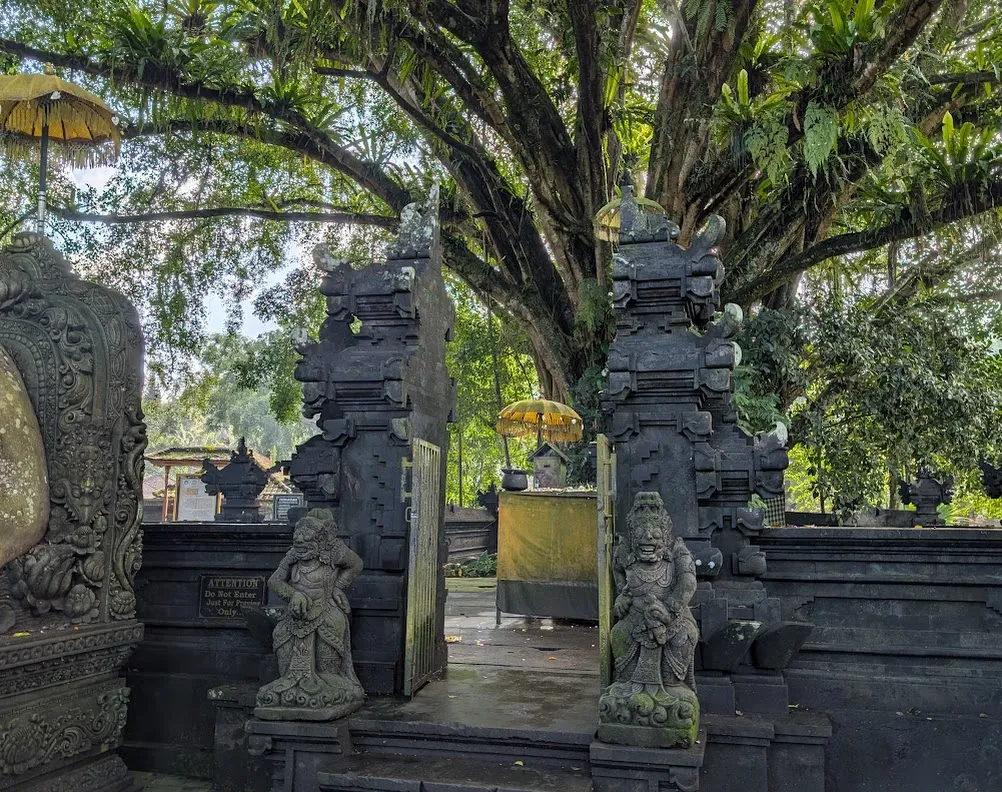
We spent Sunday visiting temples and driving through the beautiful landscape around them. I almost characterized the land as the “countryside”, but it isn’t really the countryside. Almost every part of Bali that we have seen is cultivated for farming or developed with a family compound. All families have large, multi-building, multi-generation compounds, usually with a small shrine (complete with split gates), a cooking area, a gathering area, and sleeping places.
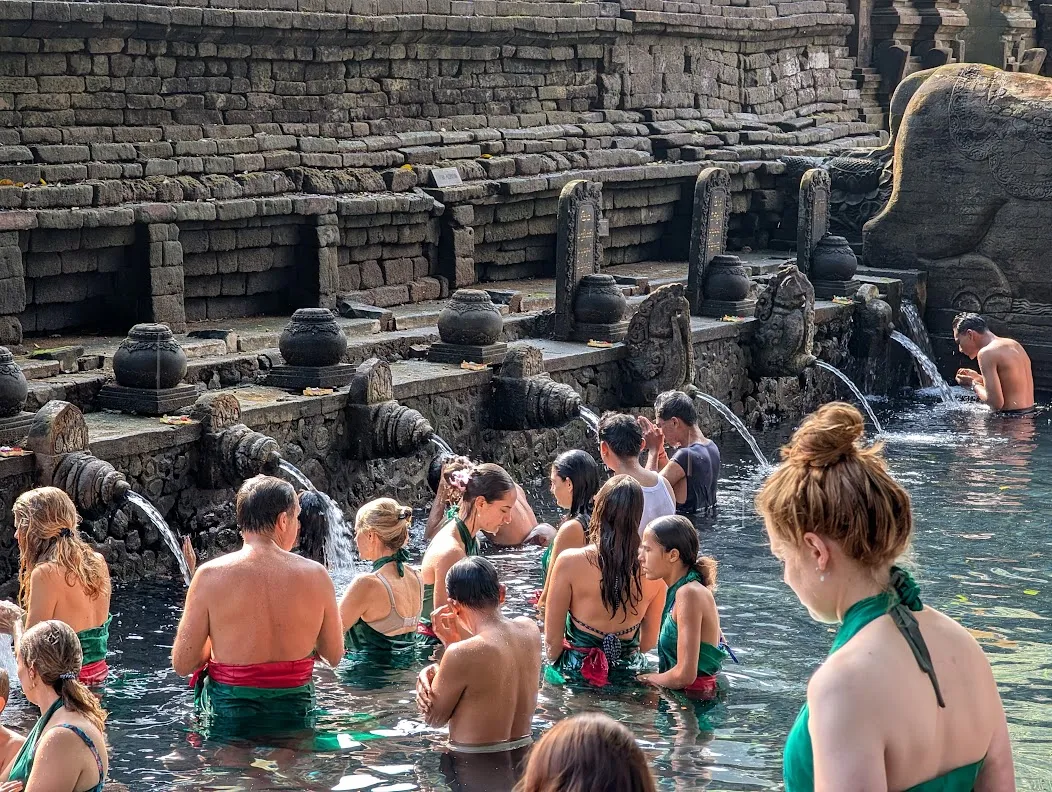
The Pura Tirta Empul temple houses a cold spring (which is rare in this volcanic land) that has been set into holy fountains. Visitors (tourist or not) who have purified themselves through prayer earlier in the temple can go into the (very cold) water and further engage with the fountains. I am honestly not sure how I feel about this; I guess that’s why I like writing. I’ll wrestle with this out loud. I like that non-Hindu tourists who are behaving respectfully are able to participate in these rituals, but on the other hand as a non-Hindu, I would never want to do that. It feels too much like a costume. On the third hand, I don’t like being wet, so this was never going to happen for me.
As I mentioned yesterday, these temples are also working temples. There were active ceremonies going on at every place we visited. I saw a pair of teenagers alternating between praying at the central shrine and taking selfies, lips pursed and hands thrown in a V.
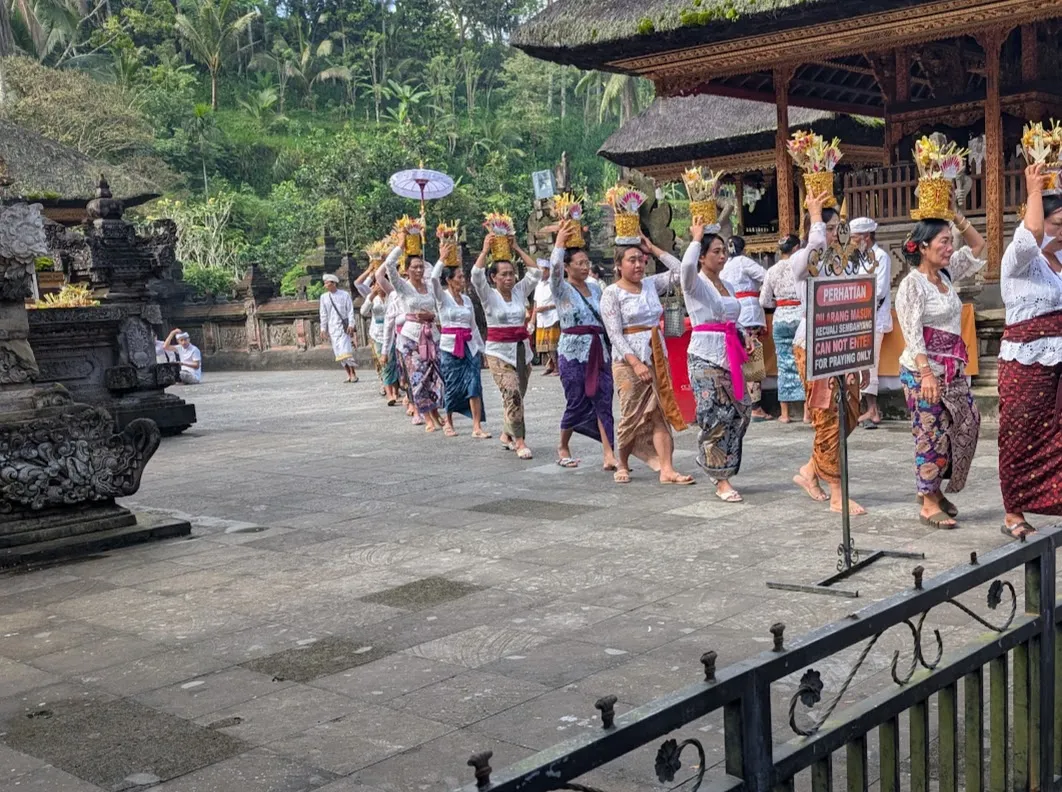
As people leave the central courtyard, some recognize Balit, our guide. They talk to him a little, he makes small talk with them (I can’t understand, of course, since he doesn’t talk to them in English, plus everyone here is super quiet all the time). Later, I asked him if he knew those folks. Balit confides in me, laughing, that he sort of did. They knew him from when he was a village spiritual leader, but he didn’t really remember who they were. I can relate.
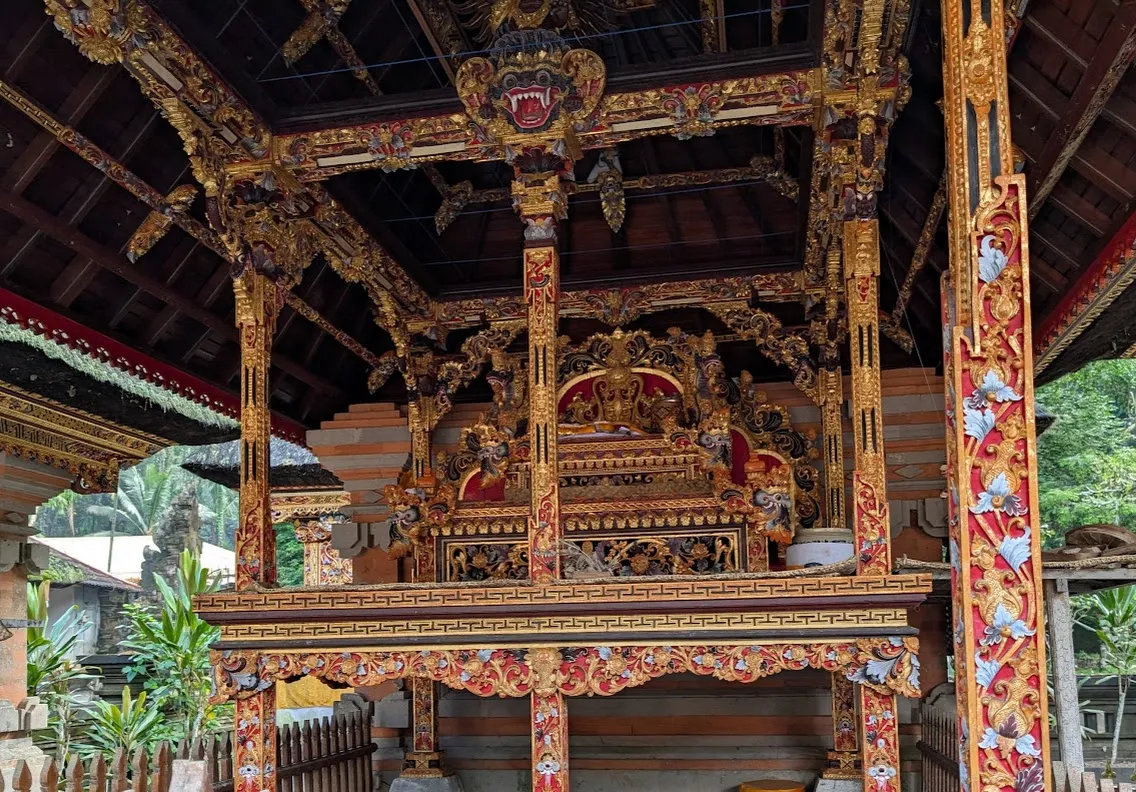
As you leave the temple, there is a different exit; you are directed through a long snaking maze of gift shops. Each shop sells more or less the same stock. I spent the time walking back and forth, wondering about the economics of the situation. Is it better to have an early stall, catching people before they realize there’s more to be had later? A later stall, when peoples’ willpower is worn down by the endless parade of goods? The items are clearly directed towards foreign visitors; how much trade can any one stall do in a week?
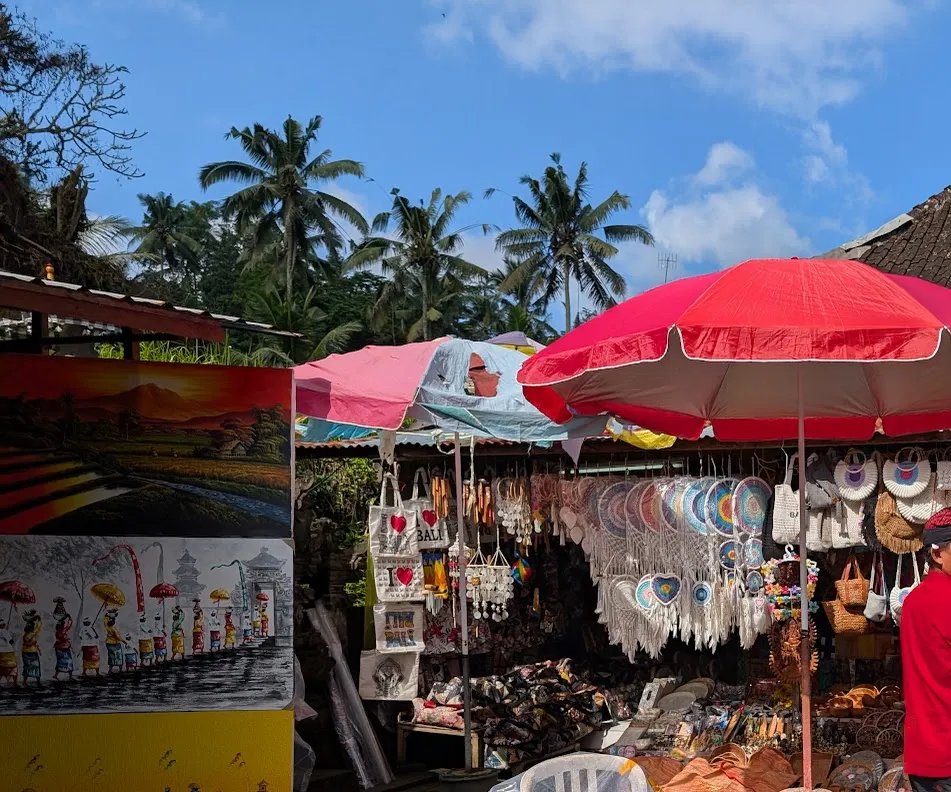
Tourism and money and capitalism and empire and colonization weigh heavily on my mind. We exit, with our guide. He and our driver have a full-time job for the week: taking care of us. I try to be polite and friendly and helpful, I do not want to be a burden or a horror story, but rather a job that he’s good at. He takes care of us, brings us water when we are hot, and explains the history of each temple we visit. Like I said yesterday, he was a spiritual leader in his village before the tour guide business took up his full attention; he knows all the stories. I am unable to retain the names, the histories. Were the two kings of Ubud sent by their father from Java? Or from elsewhere in Bali? Who was the warrior god that struck the ground with his dagger that opened the springs here at this temple? The stories wash over me, but I am not untouched. I am modified, reconfigured, by the things I do remember. Balinese Hindus hold the banyan trees as sacred, will not cut them down.
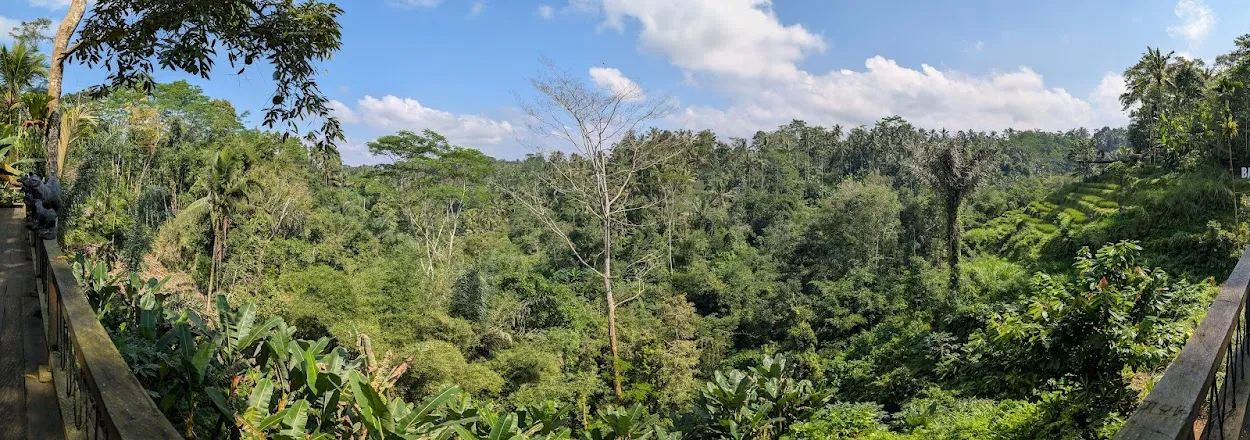
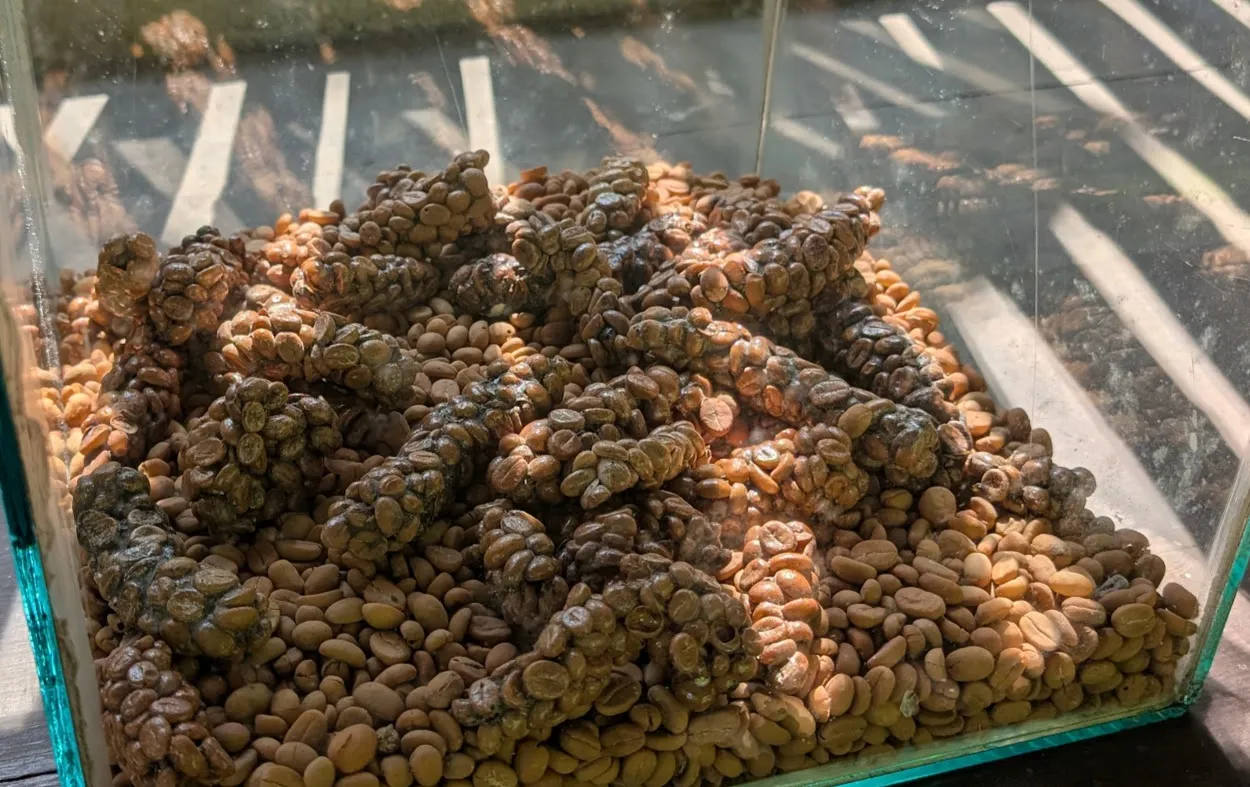
We stop at a coffee farm, Bali Cat Poo Cino. The story goes: when the Dutch had colonized the island, they required the farmers grow crops for export, but not eat those crops. So the coffee beans went elsewhere. However, the island is home to the Asian Palm Civet, who (despite being technically carnivores) mostly feed on fruits, including the coffee cherries grown here. They digest the coffee fruit and then poop out the beans. These coffee beans were readily available to eat by the farmers, since the Dutch wanted nothing to do with them. That, plus the tulip thing, make me question the overall business savvy of those Dutch colonizers. On the other hand, the farm I will repeat is named Bali Cat Poo Cino, so I dunno.
At the end of the tour, we pass a sign that says “swing toilet”, which raised a lot of questions in my head. Chrissy points out that they are probably two different things in the same direction. I prefer to consider the unified whole of it. A swing toilet, useful to fertilize the coffee farm. We are given a tasting sample of a dozen varieties of tea made from herbs grown here as well as the coffee. There are so many good flavors; I surprise myself by really liking the avocado coffee. Sweet and savory and coffee, not my usual thing, but then again I have been drinking more cappuccinos of late, so maybe my tastes have changed.
The luwak coffee (of course I ordered some to try) is prepared by roasting the beans quite heavily, and then grinding them to a fine (espresso ++) powder. A heaping spoonful of this powder is put in the cup and boiling water poured over, then it is left to cool a little and settle out. This is more or less the opposite of how I like my coffee in terms of roast, grind, preparation. On the other hand, it all comes together. The heavy roast means there’s not a lot of acid, it’s all toast in the taste, so to speak. The bitterness (despite the hot brew and fine grind) is quite low; you’d be a fool to put sugar in this. Honestly? I like it. I don’t like it enough to pay western prices for it, but I am glad I came here, glad I experienced it. The civets were cute.
Over tea, we talk to Balit about family and community. We talk about our parents and grandparents, and his as well; his grandmother lived for 116 years. In their culture, when someone dies or is married, the entire community comes together to support, to celebrate, to mourn. Balit wants to know who will take care of our parents if we are 4,000km away from them at home. Chrissy tries to explain protestant calvinism and work and its effect on american families. We agree that things are just different.
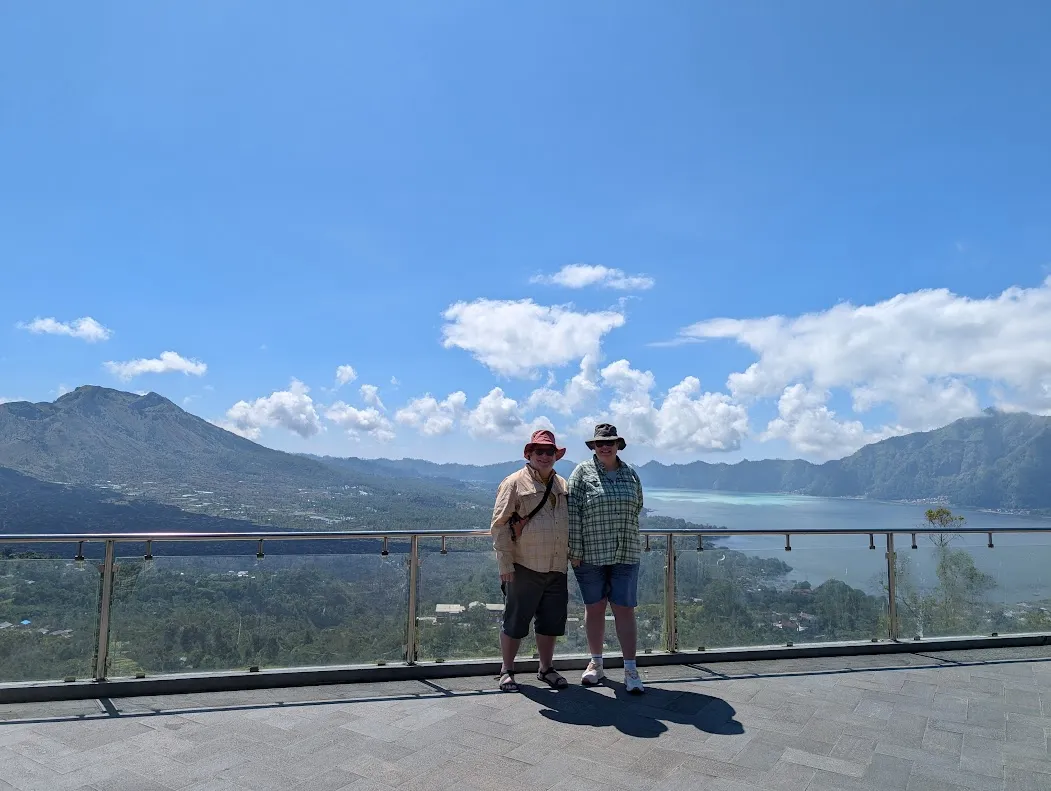
After the coffee farm, we travel north to Kintamani crater. The inner volcano, Mt Batur, is home to another temple, which we are going to visit. The views along the way are spectacular. Alongside the lake, shown in the bottom left of the below photo, you can see some villages at the lake side. Those villages are of native Balinese people, who the guide referred to as Bali Aga- they were here before the Hindus arrived from Java. According to some other research, they prefer the term Bali Mula, as Aga has overtones of “redneck” as far as I can tell. Colonization comes in waves.
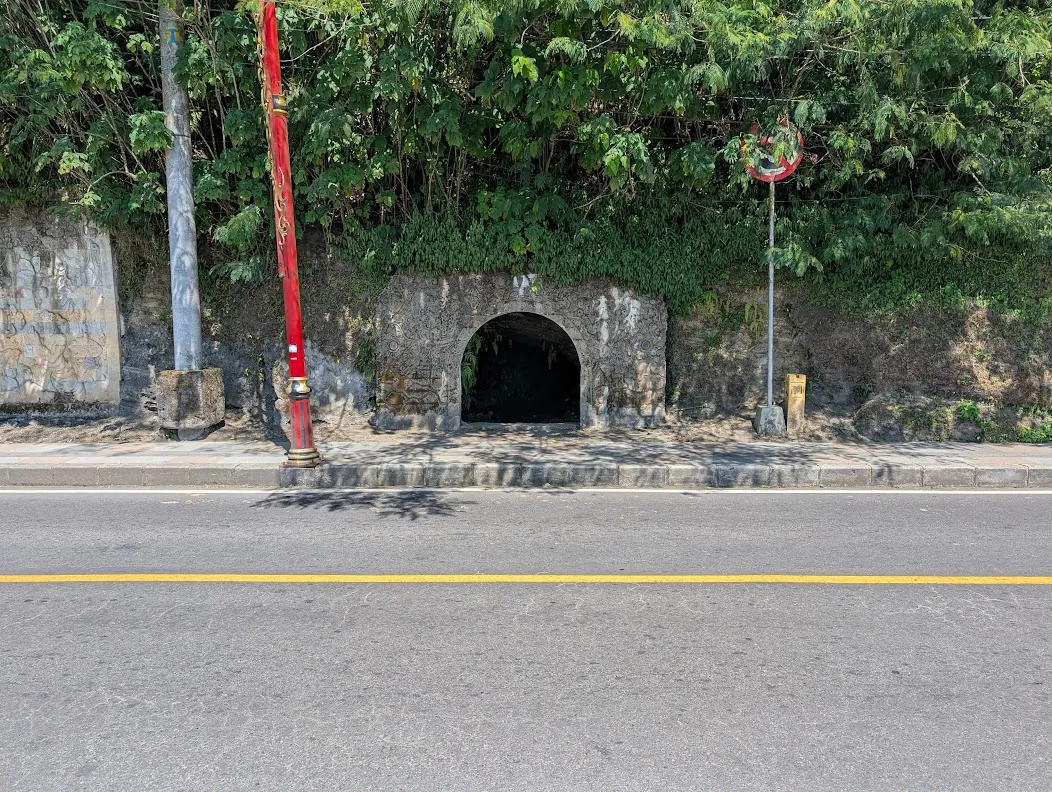
There are caves up here, which the local Balinese hid inside during the Japanese Occupation time of WWII. We go a little further up the rim mountain and have lunch. No photos from lunch, sorry. It was a great view, and the food was .. fine, nothing to compare to our lunch from the day before, but fine. There was a dude at the next table over watching something loud on his phone and smoking a cigarette. This kind of put me off my game for a bit.
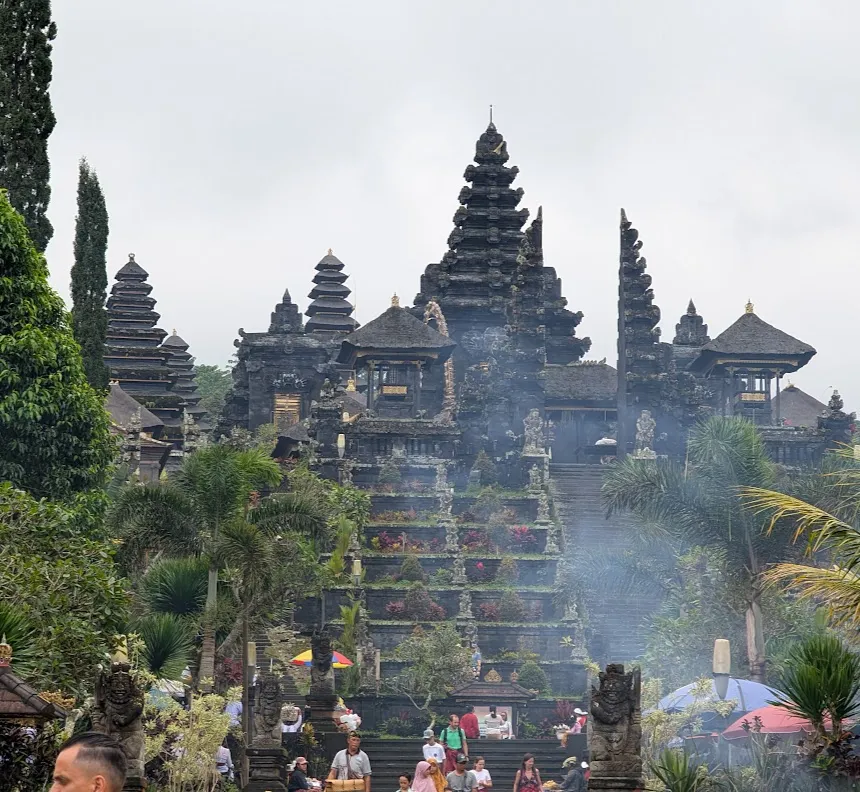
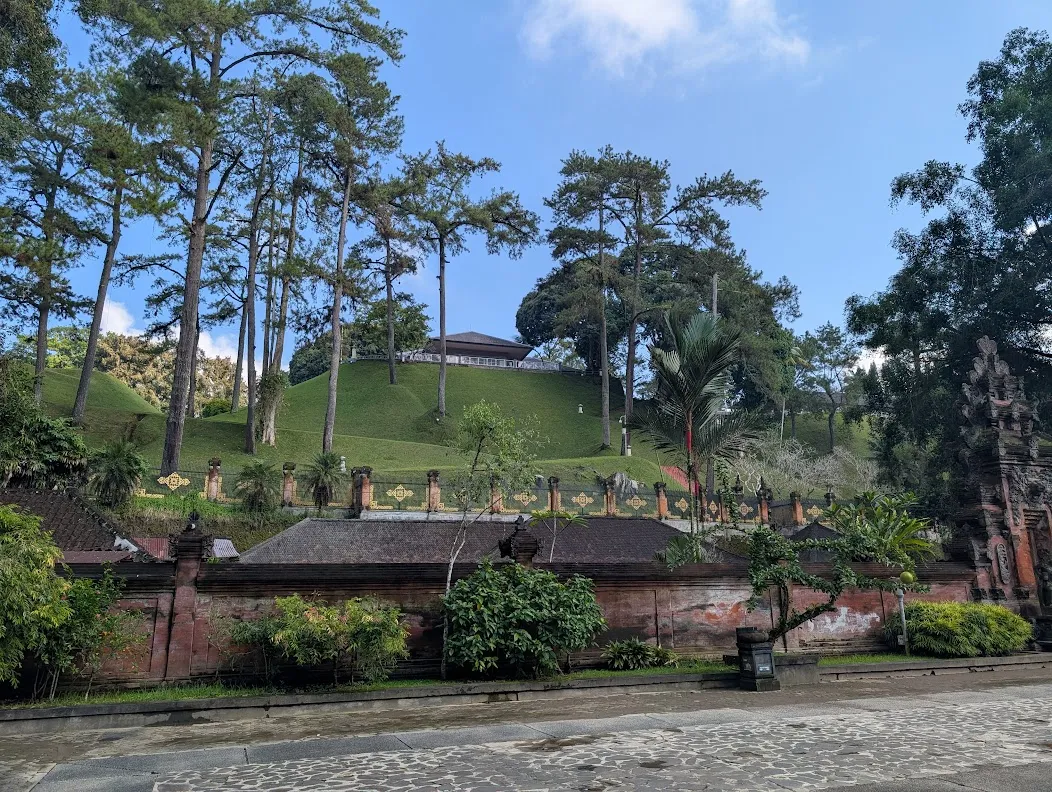
The next temple is at the base of the Agung volcano. There are, of course, other temples further up, but those are a bit of a walk. This one dates from the 10th century CE. As always, there’s a mingling of active worshipers and tourists. The tourists need to pay an entry fee; I’m happy to pay of course (it comes with an electric cart ride up to the lower plaza where I took the above photo), but I keep thinking about the mingling of the sacred and the touristic.
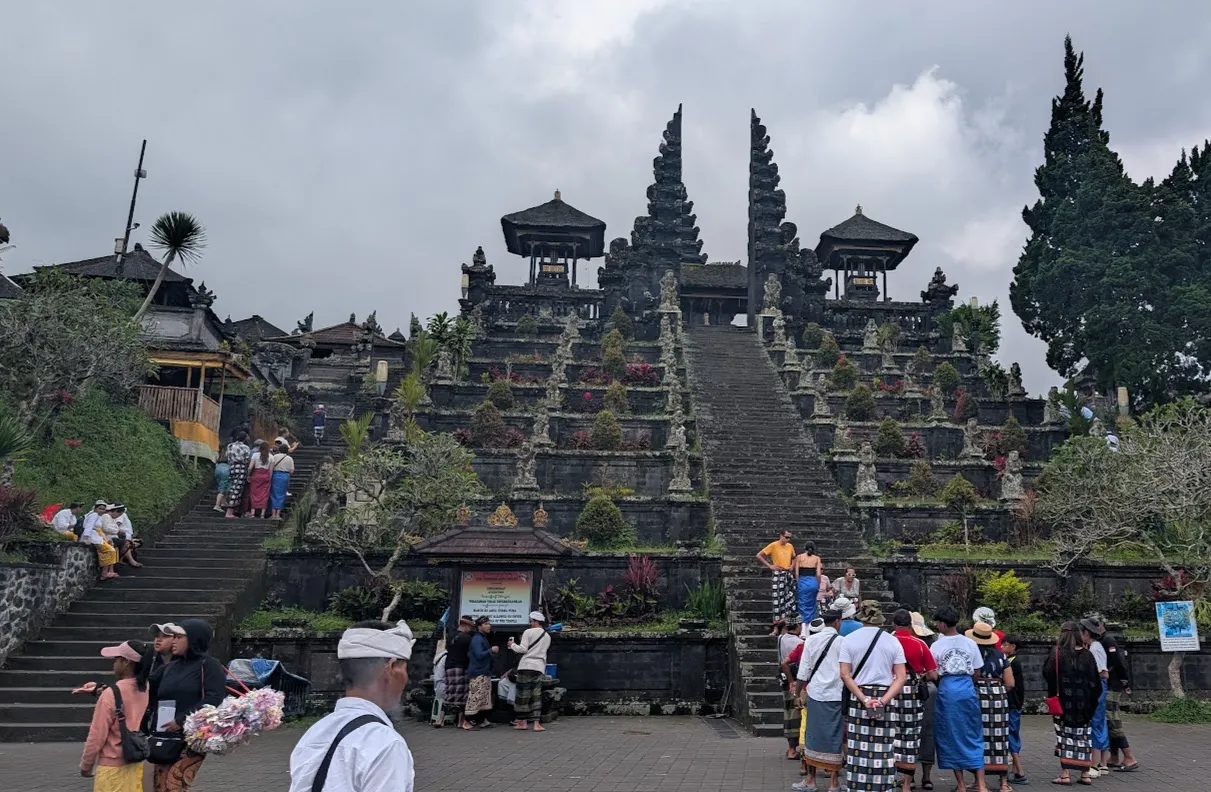
We climb the side-stairs, up the left side, and back down the right. Along the climb, there are small shops selling cold drinks and souvenirs. I learn that the clans that built the additional twenty two temples are more like guilds, but also families. There is a Smith clan, for the metalworkers, they have their own temple here. The shrines usually have multiple roofs, I learn as well, but always an odd number. Each odd number has its own symbology, so the idea that the architecture needs to evoke is shared between the Balinese Hindu viewer and the architect.
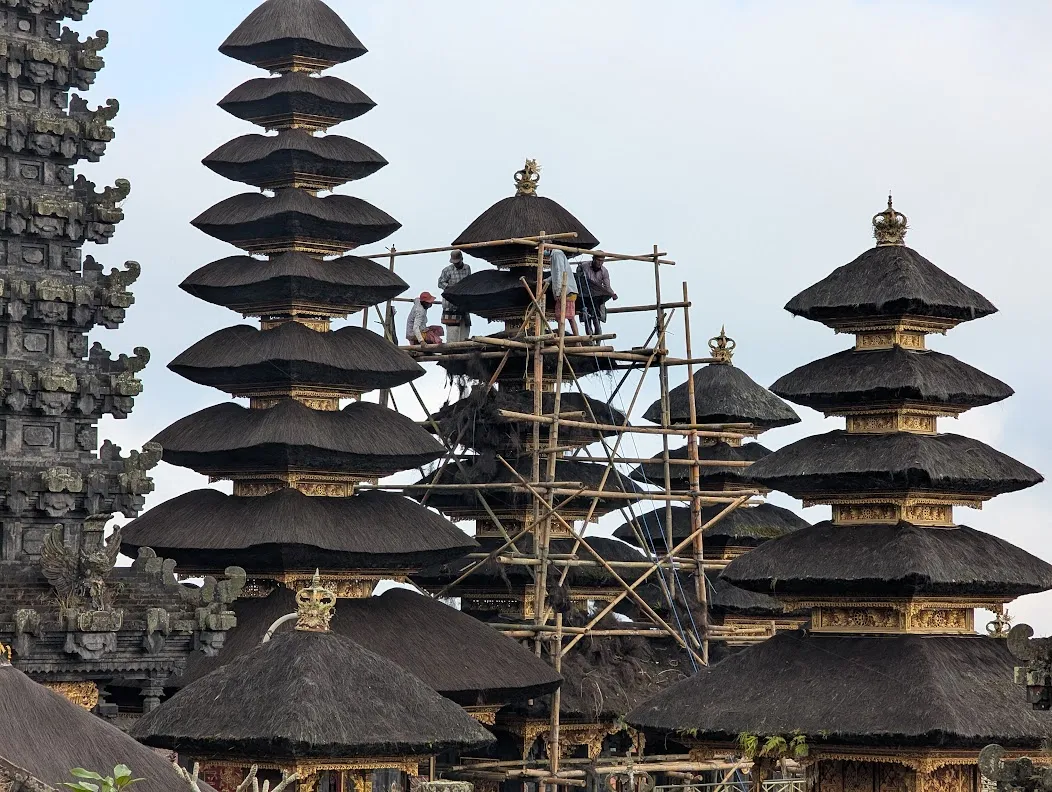
Up to the top; we see worshippers start their procession down those central steps. I feel uncomfortable filming, so I just watch. On the way back down, Balit buys a snack from a woman who reminds him of his mother.
Exhausted, we eat at the hotel and crash out. We’re still time-zoned, in the rebound period where the early exhaustion (which lets us go to sleep immediately at the right time) has worn off, so it’s a little harder to sleep local hours for the next few days.
Conversation happens inside — sign in to Overstory to read and write comments.